

My brother-in-law is French, or more precisely, Breton. When he married my sister several years ago, I was surprised that his village church was so old, dating from around the year 1000. I was even more surprised that he could trace his family back to that time in that part of Brittany.
An equally remarkable story, reaching even further back, comes from a very good Saudi friend I met in Dubai. Ahmad can trace his family back to the time of the Prophet Muhammad himself. I was amazed that someone could know their origins from 1,400 years ago.
As an exercise in understanding our family and ourselves, we took DNA tests. The results are fascinating for people like us, whose ancestry is clearly mixed: everyone in my family has traces of at least two continents, and some of us have three in our genetic make-up.
In my brother-in-law’s case, the mixture came from the Celtic regions of France, England and Ireland: essentially the same genetic group.
My maternal grandfather was Spanish, although he was born in Cuba. His parents were Asturians who emigrated to Cuba at the beginning of the twentieth century, when they were practically children. The circumstances and reasons for their migration are not fully known. Spain was involved in several wars around that time: the Philippines, Cuba and Morocco. It always seemed curious to me that they emigrated to Cuba around the time of the Caribbean country’s independence, but that is what happened. Conditions in rural Asturias 125 years ago must have been harsh and impoverished. An irony, considering what we can see today in that region and the villages of Somiedo and Narcea.

Years later, in 1941, my great-grandparents and their four Cuban-born children emigrated again, this time to Mexico. When my grandfather arrived in Mexico, he was Spanish and spoke like a Cuban.
A few years later he met my grandmother at a festival where young Spaniards gathered, alongside the Republican refugees from the Spanish Civil War who were arriving at that time.
My maternal grandparents thus formed a family closely connected to Spanish traditions. My mother listened to zarzuela and accompanied her father to Café Blanca in Mexico City’s historic centre, where fellow Spaniards would meet.
My grandfather died almost a year before I was born. He was 47. The pain of losing their father was so great that little was said about him, and we certainly did not fully practise or live the traditions his family had brought from Asturias and Cuba. Yet his attitudes, ideas and culture have always been with me. My leaning towards the left, sympathy for the Cuban Revolution and a wealth of Spanish music are part of the inheritance I received from a grandfather I never knew.
We all have four grandparents. On my father’s side, my grandparents were born, grew up and died in a village in Tierra Caliente, Guerrero, Mexico. It is a region historically marked by conflict involving Indigenous peoples, as far back as records go, and now by drug trafficking. Many historical events associated with independence, the French intervention and the revolution took place there. Those who passed through brought traditions and genes that added to the rich mixture of ancestries already present since colonial times.
That is why French surnames, light-coloured eyes known as ojos zarcos, and blond hair appear in some villages and families in the region. My paternal grandfather’s father was blond and had light eyes, a striking and noticeable physical trait.
My paternal grandmother’s father, who had a French surname, came from a village in the region. When my father was young, he would tell him: “I’ll take you there so you can see the pretty girls with light eyes.”
The region’s natural wealth, together with its complex and exquisite musical and culinary culture, is extraordinary. Yet opportunities for work and well-being were, and remain, scarce. My grandfather, a proud farmer with a gift for thinking about the future unlike anyone I have known, decided with my grandmother that a better future for their children lay outside that region, in Mexico City. Beyond that, the whole family clearly understood that progress meant studying and working. The only path my family saw out of material poverty was through study and work, with dedication and effort. Staying in the village meant being condemned to being “screwed” for life. Studying was also about more than escaping poverty: it meant opening the mind, learning more, understanding and changing the framework through which they saw the world. It was not simply a question of a better financial position, but of becoming people who used their minds to expand their way of existing. And this effort was not exclusively individual; it was understood as collective, with the family and the state supporting the individual.
My grandfather’s unconventional vision meant that eight of his nine children—three daughters and six sons—completed at least a professional degree. In the next generation, mine, 15 grandchildren went to university, many of us multilingual and holding master’s degrees or doctorates. Mentioning these achievements reflects the expectations we grew up with and how we understand our place in the world, rather than arrogance. For us, effort and dedication bring results in the future. In our view, someone who cultivates their talent and asks the best of themselves will have a better life, but above all the satisfaction of contributing to themselves, their family and the planet. We also firmly believe that the family is an environment that contributes, and should contribute, to people’s growth, so achievements and setbacks are shared.
I wish that village in Tierra Caliente had offered, and still offered, better opportunities for everyone from there, but it does not. Migration, and the effort involved in moving from a village to the city, came at a high price for my father, his siblings and their parents.
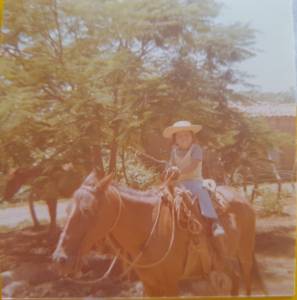
For me, this outlook and my very close relationship with my paternal grandparents made me feel native to that village in Tierra Caliente. From a very young age I spent entire holidays with them. Riding a horse or donkey, herding and milking the cows, chasing the chickens, standing by the comal to eat freshly made tortillas, or grinding ingredients for my grandfather’s mole were the best things that could happen to me.
At school in Mexico City, I had some problems because I kept the village way of speaking, and perhaps I was a little wild. Meanwhile, in the village I was the guache, the city kid who did not come from there, even if I could ride very well. This duality never weighed on me; I have always felt fortunate to be who I am.
So I am from Tierra Caliente, proudly inheriting my paternal grandparents’ outlook, traditions, words, food and music. But I am also an heir to Asturias, although I know little about what that means. Now I must recognise and embrace what that part of my origins represents. Now, by choice, I am Portuguese too. I arrived in Portugal six years ago and feel happy and grateful to be here.
I am Mexican, Asturian and Portuguese, by conviction and genetics. Reaching this conclusion gives me great satisfaction, because being Portuguese or Asturian does not make me feel any less Mexican, or vice versa. It is also true that I am not, or do not feel, 100% from any one place. This feeling surfaces when my parents or sister refer to us as “the Portuguese”, or when my sister’s family in France are called “the Mexicans”.
I find immense richness in realising that my identity, with its many origins, is not a zero-sum equation. Each place, tradition, food and word that I recognise as part of my heritage and choices excludes none of the others.
Identity matters because it gives us a place in the world: it connects our personal history to collective history, enables mutual recognition and sustains a sense of dignity, belonging and purpose.
A person’s identity is the collection of traits, experiences, relationships and meanings through which they recognise themselves and are recognised by others. It is neither fixed nor purely individual: it develops over time, in relation to the environment, other people and historical circumstances.
What, then, is the migrant’s identity? Migrants constantly face the question:
Who am I now, far from the place where I was someone? For many people this question is tormenting, but I believe its answer can be enriching and reassuring.
Migrants rebuild their sense of belonging between several places, languages and values.
Having a genetic connection or a sense of belonging to a place does not automatically make you part of its culture; rather, it opens a door to an encounter.
For a while, I believed my identity could be justified by my genetic origins: if my DNA identified me as Mexican, Spanish and Portuguese, then this was more than a feeling; it was a material truth confirming my belonging. I adopted the traditions, languages and values of those places, convinced that my cultural appropriation was therefore legitimate. But no.
Cultural belonging does not come exclusively from blood, but also from integration, recognition and reciprocity. Feeling or carrying biological inheritances is not enough: we must participate, contribute and allow ourselves to be transformed. Only then does our relationship with a culture cease to be appropriation and become a bond.
My genetic connection encourages me to discover, understand and share the cultures reflected in my DNA, but I do not claim them as property. I recognise them as a shared inheritance.
That makes belonging a process, rather than a proclamation. Identity then becomes an act of storytelling: migrants tell their own stories and listen to others, and in doing so, remake themselves.
Migrants who are recognised neither in their country of origin, because they have changed, nor in their new country, because they do not entirely belong, inhabit an intermediate space, an in-between place.
But that space, however painful, can be creative: it is where hybrid, transcultural identities emerge, blending languages, memories and sensibilities.
Not being recognised can hurt, but it also opens up the possibility of inventing new ways of being and belonging.